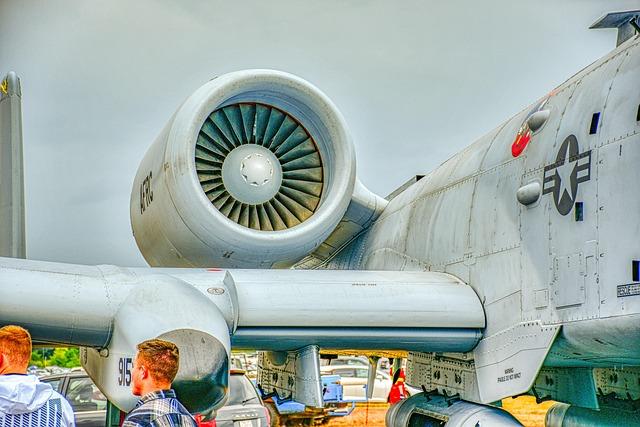
Iran’s downing of a U.S. A-10 Thunderbolt II, commonly known as the “Warthog,” has jolted global markets and sharpened fears of a wider confrontation in the Gulf region. The incident, which Tehran claims occurred after the aircraft violated its airspace, marks one of the most serious direct clashes involving American military hardware in recent years. As Washington weighs its response and regional capitals scramble to reassess their risk exposure,investors in London and other financial hubs are bracing for potential turbulence in energy prices,shipping routes,and defense stocks. This article examines what is known about the shootdown, the immediate geopolitical fallout, and the implications for businesses and markets that are already navigating a fragile global economic environment.
Immediate geopolitical fallout and risks of escalation after the A 10 downing
The destruction of a US A-10 over or near Iranian airspace has jolted already fragile regional fault lines, forcing capitals from Washington to Riyadh into rapid crisis-management mode. Overnight, military hotlines, back-channel diplomatic channels and energy market desks have all lit up as decision-makers weigh retaliation against restraint. Early signals suggest a scramble to contain the incident rather than allow it to spiral, yet the symbolism of a NATO combat aircraft being downed by Iran places enormous pressure on Western leaders. In London, policymakers are confronting a triple challenge: reassuring markets, aligning with US security commitments, and avoiding automatic escalation that could ensnare UK assets in the Gulf. This is particularly acute given the proximity of key maritime chokepoints and the UK’s commercial exposure to both oil flows and regional aviation routes.
- Risk of rapid military miscalculation along congested air and sea corridors
- Heightened cyber and hybrid threats against Western energy and financial infrastructure
- Increased vulnerability for commercial shipping and insurance premiums in the Strait of Hormuz
- Intensified proxy activity across Iraq, Syria, Lebanon and Yemen
| Scenario | Short-term Risk | Market Impact |
|---|---|---|
| Limited reprisal strike | Controlled but tense | Oil spike, risk-off assets bid |
| Carrier group build-up | Prolonged standoff | Volatility in FX and equities |
| Diplomatic de-escalation | Managed containment | Brief shock, then correction |
For London’s business community, the incident is being read less as an isolated military clash and more as a stress test of global crisis architecture.Diplomats at the UN Security Council will likely push for urgent consultations, while EU partners gauge whether to revive or reframe past nuclear and security frameworks involving Tehran. At the same time, defence analysts are warning that the window for technical “incidents” to become political “casus belli” is dangerously narrow, particularly if additional assets are lost or if casualties mount. The overriding question for investors, insurers and energy traders is whether this episode remains a sharp but containable shock, or the opening act of a more entrenched confrontation that redraws risk premiums for the Gulf – and, by extension, for London’s role as a global financial hub.
Operational vulnerabilities exposed in close air support missions over contested airspace
The loss of the A-10 over Iranian-defended skies has thrown a harsh spotlight on how legacy close air support platforms operate when modern integrated air defence systems are fully active, not suppressed. Designed in an era of assumed air superiority, the aircraft’s low-speed, low-altitude attack profile made it highly effective against armoured columns in permissive environments but dangerously predictable in a battlespace layered with radar-guided missiles, mobile launchers, and electronic warfare. Intelligence sources suggest that the aircraft followed a repeatable racetrack pattern to support ground forces,allowing Iranian operators to build a digital fingerprint of its movements and time their engagement window. That pattern-based predictability,once a strength for coordinating with troops in contact,became a liability as adversaries adapted faster than mission tactics did.
Military analysts now point to structural gaps in the mission design process rather than a single tactical error in the cockpit.Inadequate integration of real-time threat data, limited stand‑off weapon options, and the absence of autonomous decoys or loyal wingman drones left the aircraft exposed and largely alone inside a rapidly shifting kill zone. Key shortcomings highlighted by defence officials include:
- Legacy airframes struggling to survive against networked, mobile air defences.
- Slow sensor-to-shooter loops between intelligence feeds, command centres, and the aircraft.
- Insufficient electronic warfare coverage to degrade or confuse hostile targeting radars.
- Overreliance on predictable flight paths to maintain visual contact with ground units.
| Vulnerability | Operational Impact |
|---|---|
| Low-altitude, slow speed runs | Extended exposure to SAM envelopes |
| Limited stand-off weapons | Forced entry into high-risk airspace |
| Fragmented threat intelligence | Delayed route and tactics adjustments |
| Single-platform CAS model | No layered defence or decoy options |
Implications for NATO defense posture and regional force deployment strategies
For NATO planners, the downing of the A‑10 is less a tactical loss than a strategic wake‑up call. It exposes how quickly legacy airframes can become vulnerable in contested airspace shaped by layered Iranian air defenses, proxy militias and anti‑access/area denial (A2/AD) systems stretching from the Gulf to the Eastern Mediterranean. This is likely to accelerate a recalibration of alliance posture, with renewed emphasis on survivability, dispersion and redundancy over traditional notions of air superiority. Expect more emphasis on agile basing concepts, hardened infrastructure and forward‑deployed air and missile defense assets, particularly in states bordering the Black Sea and Eastern Mediterranean.
In practical terms, NATO force planners are already sketching new deployment patterns that lower the exposure of slow, low‑flying platforms and increase the role of unmanned and stand‑off capabilities. Regional commanders are examining mixed packages of manned and unmanned systems, backed by cyber and electronic warfare assets, to probe and degrade hostile air defense networks without escalating into a full‑scale confrontation. Key emerging priorities include:
- Rotational micro‑deployments of fighter and ISR squadrons across multiple regional airfields.
- Forward stockpiling of precision munitions and air defense interceptors in southeastern Europe.
- Integrated early‑warning networks linking Gulf partners,NATO naval groups and European air commands.
- Expanded naval patrols with air defense-equipped frigates in choke points such as the Strait of Hormuz and Eastern Med.
| Adjustment | Primary Goal | Region Focus |
|---|---|---|
| Agile air basing | Reduce vulnerability | Black Sea rim |
| Enhanced air defenses | Shield critical hubs | Eastern Med |
| Unmanned strike assets | Limit pilot risk | Gulf airspace |
Policy recommendations for deconfliction protocols and future air operations in the Gulf region
Western and regional planners are now under pressure to codify clearer, more resilient channels for avoiding accidental escalation in one of the world’s most crowded air corridors. Analysts say any updated playbook must move beyond ad hoc “hotlines” and embrace layered, tech-enabled communication, including encrypted real-time data links shared between rival air defence networks and coalition task forces. To rebuild a margin for error, defence ministries are quietly discussing a Gulf-wide airspace notification framework, bolstered by mandatory, tamper-proof transponder use for all military aircraft operating within agreed corridors. Within this framework, independent verification mechanisms involving neutral states or international organisations could help arbitrate disputes when radar tracks and cockpit recordings tell different stories.
- Shared incident-reporting platforms for near-miss events
- Time-bound engagement rules requiring multiple identification checks
- Joint simulation drills involving rival air forces and naval units
- Codified no-go zones around critical infrastructure and busy commercial routes
| Priority Area | Recommended Action |
|---|---|
| Communication | 24/7 multilingual air-ops hotlines |
| Clarity | Pre-flight notifications for patrols |
| Technology | Common IFF and tracking standards |
| Oversight | Quarterly reviews by a neutral panel |
Looking ahead,Gulf air operations are likely to evolve toward more dispersed,unmanned-heavy postures,a shift that will test existing doctrines built around crewed fighters and close air support platforms like the A-10. This makes it vital to future-proof agreements so they also cover drones, loitering munitions, and cyber elements that can interfere with navigation or command systems. Regional policymakers are weighing proposals for a Gulf Aerial Safety Compact that ties access to shared intelligence and training to compliance with stricter identification, notification and engagement rules. Without such binding, verifiable standards, each new incident risks becoming not just a tactical loss, but a strategic failure in managing an already fragile security architecture.
To Wrap It Up
As investigations continue and officials in Tehran, Washington, and European capitals trade accusations and reassurances, the downing of an American A-10 over Iranian territory marks a sharp escalation in an already volatile region. Beyond the immediate questions of rules of engagement and airspace violations, the incident exposes just how narrow the margin for error has become in the Persian Gulf-where miscalculation, technical failure, or a single misread radar return can ripple quickly through global markets and diplomatic alliances.
For now, the world’s attention turns to what comes next: the findings of any formal inquiry, the tenor of the responses in Washington and Tehran, and the ability of international partners to prevent a military flashpoint from hardening into a broader crisis. Whether this becomes a fleeting confrontation or a defining moment in Western-Iranian relations will depend less on what happened in the skies over Iran, and more on the decisions taken in the days and weeks that follow.