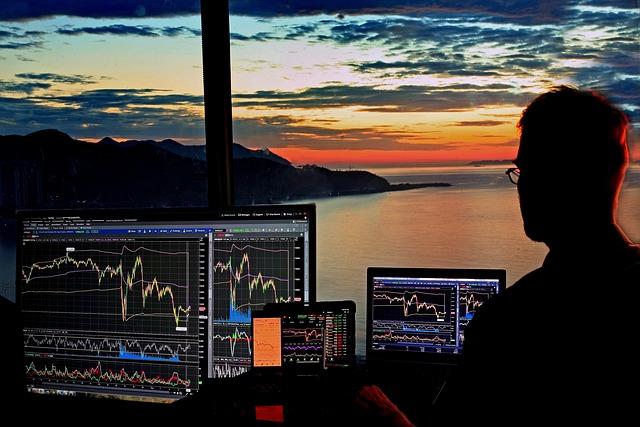
In 2026, cryptocurrency is no longer a fringe experiment-it is a maturing asset class woven into the fabric of global finance, and London is one of its busiest crossroads. But as digital tokens proliferate and market cycles accelerate,investors are discovering that intuition and hype are no match for the speed and complexity of today’s crypto markets. From AI-driven trading models to on-chain analytics and real-time regulatory monitoring,a new generation of tools is reshaping how both institutions and retail investors make decisions.
For London’s traders, asset managers and fintech entrepreneurs, the question is no longer whether to use technology in crypto investing, but how intelligently it is being deployed. As policymakers tighten oversight and market structure evolves,staying ahead requires not just access to data,but the ability to interpret it with precision. This article explores the key technologies redefining crypto decision-making in 2026, the risks and opportunities they present, and what they mean for the City’s position as a global hub for digital asset innovation.
Harnessing AI driven analytics platforms to navigate volatile crypto markets in 2026
In a market where token prices can swing 20% in an afternoon, investors are increasingly turning to AI analytics suites that resemble institutional trading floors more than hobbyist dashboards. These platforms ingest vast streams of on-chain data, order book depth, derivatives funding rates, macro indicators and even court filings, then surface patterns humans would miss in a live London trading session. Instead of scrolling through dozens of charts, traders are leaning on predictive models that flag emerging risk regimes, liquidity crunches and sentiment inflection points in real time. Many tools now offer natural-language queries-type “show me altcoins with rising on-chain activity but declining exchange reserves” and the system responds with curated shortlists, confidence scores and historical performance, tailored to the user’s risk profile.
What distinguishes the most effective AI stacks in 2026 is their ability to convert raw volatility into structured decision frameworks. Sophisticated investors are layering platforms that provide:
- Regime detection – clustering market conditions into “trend”, “chop” or “panic” modes.
- On-chain forensics – tracking whale wallets, validator behavior and bridge flows.
- Regulatory heat maps – monitoring policy developments in key hubs like London, Brussels and Singapore.
- Portfolio stress-testing – scenario analysis across interest-rate shocks and liquidity droughts.
| AI Signal | What It Tracks | Typical Use Case |
|---|---|---|
| Volatility clustering | Short-term price shocks | Adjusting leverage and position size |
| Whale concentration | Large wallet inflows/outflows | Timing entries around accumulation |
| Funding rate bias | Perpetual swap sentiment | Spot vs. derivatives hedging |
| Regulatory sentiment | News,speeches,draft rules | Geographic allocation and listings |
Using on chain data and transparent metrics to separate sustainable projects from speculative hype
In 2026,serious investors are turning away from influencer-driven narratives and towards the cold clarity of on-chain evidence. Every transaction, token issuance and liquidity movement is recorded permanently, allowing market participants to scrutinise whether a project’s growth is organic or engineered. Smart dashboards now surface live wallet activity, exchange flows and staking behaviour, making it easier to spot red flags such as sudden concentration of tokens in a few wallets or aggressive minting schedules. Instead of trusting glossy pitch decks, investors can interrogate the underlying numbers and ask whether user adoption, developer activity and capital allocation justify a project’s valuation. London’s growing community of digital asset analysts is increasingly treating blockchains as open ledgers for financial due diligence, not as black boxes for speculation.
To make this data usable, investors are combining analytics platforms with clear, transparent metrics that resemble the fundamentals used in traditional markets. Key indicators-such as real fee revenue, user retention and token distribution-are becoming standard checkpoints for separating durable business models from momentum trades. Practical filters include:
- Wallet diversity: broad, growing holder base vs. a handful of dominant whales.
- Revenue sustainability: recurring protocol fees, not just token emissions.
- Liquidity quality: deep, stable liquidity across multiple venues.
- Developer activity: consistent code commits and audited updates.
| Metric | Sustainable Signal | Speculative Warning |
|---|---|---|
| Active wallets (30d) | Stable growth | Sharp spikes,fast drop |
| Token holders | Diverse,decentralised | Highly concentrated |
| Protocol fees | Driven by usage | Subsidised by incentives |
| Liquidity | Organic and persistent | Short-lived farm boosts |
Integrating automated trading tools with human oversight to reduce risk and execution errors
In 2026,the most sophisticated crypto desks in London are no longer asking whether to automate,but how tightly to weave algorithms into human decision-making.Trading bots now scan dozens of venues in milliseconds, applying pre-set rules to capture small price discrepancies, manage position sizes and enforce stop-losses with machine precision. Yet the firms outperforming their peers are those treating automation as an assistant, not an autopilot. Senior traders set the strategy, codify guardrails and maintain the power to pause or override systems when market behaviour breaks from historical patterns. This hybrid model is reshaping risk culture, with desks combining quantitative models and human judgment to build what amounts to a dual-control cockpit for every major trade.
London-based firms are increasingly layering real-time oversight, tiered permissions and post-trade analytics onto their crypto stacks to curb operational mistakes and rogue trades. Typical workflows now include:
- Approval thresholds for orders above a certain size or leverage level.
- Pre-trade checks that block orders breaching risk or compliance rules.
- Live dashboards showing system health, slippage and exposure by asset.
- Kill switches enabling instant shutdown of malfunctioning algorithms.
- Audit trails to trace every automated and manual intervention.
| Tool | Human Role | Risk Benefit |
|---|---|---|
| Smart order router | Sets venue preferences | Cuts execution slippage |
| Risk engine | Defines limits | Prevents outsized losses |
| Monitoring dashboard | Flags anomalies | Speeds crisis response |
| Backtesting suite | Validates rules | Reduces model error |
Adapting UK regulatory tech solutions to ensure compliant crypto investing from London
Regulatory technology born in London’s financial district is rapidly being repurposed for digital assets,giving both retail and institutional investors new tools to stay on the right side of the FCA rulebook. Rather of generic,global dashboards,2026’s leading platforms now hard‑wire UK‑specific requirements into their code: automated checks against FCA warnings,MiCA‑aligned disclosures for cross‑border trades,and real‑time tax tagging that mirrors HMRC guidance. The newest systems plug directly into exchange APIs and private wallets, flagging high‑risk tokens and non‑compliant promotions before a trade is executed, not months later when an auditor reviews the books. For London firms fighting to keep compliance costs under control, this is less about shiny front‑end apps and more about deeply integrated engines that sit beneath trading desks, custody solutions and treasury platforms.
- Smart KYC/AML filters that screen counterparties against UK and EU sanctions lists in milliseconds.
- Geo-fenced access controls that stop staff in London from breaching local marketing or solicitation rules.
- On-chain analytics tuned to FCA risk typologies, not just generic fraud patterns.
- Tax-ready exports that map every crypto move to UK capital gains and income categories.
| RegTech Focus | London Use Case | Compliance Edge |
|---|---|---|
| Real-time wallet screening | Trading desks in Canary Wharf | Blocks sanctioned flow before settlement |
| Promotion monitoring | Finfluencers and brokers | Pre-checks FCA crypto ad rules |
| Proof-of-reserves reporting | London-based custodians | Machine-readable audits for regulators |
To Conclude
As the crypto landscape matures and regulation, institutional participation and mainstream adoption deepen, the edge will increasingly belong to those who can separate signal from noise. In 2026, that means treating technology not as a speculative shortcut, but as an analytical partner: using data, automation and AI to stress-test assumptions, map risk and uncover opportunities that would be invisible to the naked eye.For London’s investors, entrepreneurs and policymakers, the challenge is now less about whether to engage with digital assets and more about how to build the right technological toolkit around them. Those who invest in robust infrastructure, cultivate digital literacy and remain clear-eyed about both the promise and the pitfalls of automation will be best placed to navigate the next cycle.
Cryptocurrency may remain volatile, but decision-making does not have to be. In an era defined by abundant data and increasingly sophisticated tools, smarter crypto strategies will come not from chasing the next hype, but from harnessing technology to ask better questions-and insisting on evidence-based answers.