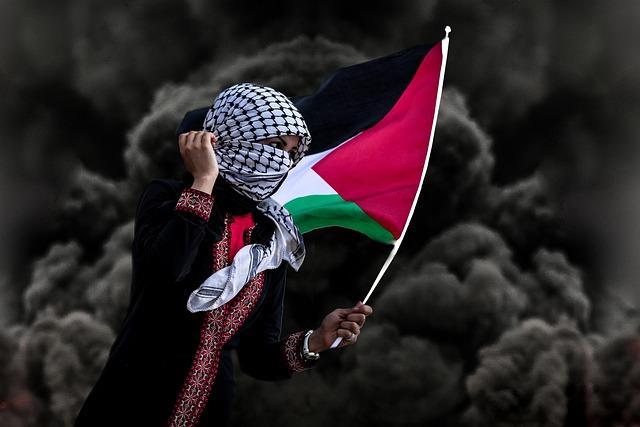
Tens of thousands of protesters converged on central London this weekend for a rally over the war in Gaza, in a mass gathering that was at once a commemoration of lives lost, a demand for political action, and a test of Britain’s commitment to free expression. Against a backdrop of heightened tensions, police scrutiny and fierce political debate, the march laid bare the complex mix of grief, anger and solidarity that now shapes the UK’s response to the conflict. This was not only a demonstration about events thousands of miles away; it was also a revealing snapshot of how deeply the war has penetrated British public life – and of the contested lines between protest, public order and politics on home soil.
Commemoration and grief in the heart of London examining how personal loss shapes the Gaza rally
Amid the chants and placards,the demonstration unfolds as an improvised memorial ground. Families carry laminated photos of missing or dead relatives, some taped to cardboard, others held close like fragile relics. Names are recited in low voices between the shouted slogans, as if refusing to let them dissolve into statistics. Handwritten messages – “brother”, “daughter”, “best friend” – turn abstract geopolitics into a tapestry of interrupted lives. For many,attending is less an act of political alignment than a ritual of mourning,a way to mark the passing of loved ones when no grave is near and no official ceremony is possible. In this public space, remembrance is both personal and collective, shaped by those who are trying to process trauma in real time.
That grief steers the mood, the symbols and even the language of the march. Protest signs double as eulogies,vigil candles appear alongside megaphones,and speakers pause to allow moments of silence that cut through the noise of central London. People describe coming not just to protest, but to:
- Say the names of relatives and friends lost in Gaza
- Share testimonies that rarely reach mainstream platforms
- Find community in a city often perceived as emotionally distant
- Demand accountability framed through the stories of the dead
| Form of grief | How it appears at the rally |
|---|---|
| Personal loss | Photos, names, dates on placards |
| Collective mourning | Chants, prayers, shared silence |
| Seeking justice | Speeches linking stories to policy demands |
From symbolic gestures to street tactics understanding how protest culture is evolving in the UK
Once defined by placards, marches and carefully negotiated routes, demonstrations in Britain are increasingly shaped by visibility wars and digital choreography.Classic symbols – peace signs,national flags,keffiyehs – now sit alongside QR codes linking to live petitions,encrypted group chats and livestream overlays that turn a single march into a networked media event. Protesters switch between roles as mourners, witnesses and content producers, conscious that an image shared within seconds may travel further than any chant. This shift blurs the line between symbolic gesture and tactical action: a vigil becomes a data point in a campaign, while a banner is designed as much for the camera lens as for the crowd.
- Symbolic acts amplified through social media narratives
- Physical disruption calibrated to test police thresholds
- Digital coordination via encrypted apps and broadcast channels
- Message discipline negotiated across diverse grassroots groups
| Past Focus | Emerging Focus |
|---|---|
| Crowd size | Online reach |
| Single-day marches | Rolling, recurring actions |
| Printed leaflets | Shareable digital toolkits |
| Set-piece rallies | Mobile, tactical clusters |
On London’s streets, this evolution is visible in how routes are chosen, how crowds are organised and how slogans are framed to withstand legal and political scrutiny. Campaigners weigh up whether to block a major junction, stage a silent march or coordinate a nationwide “day of action”, knowing each carries different risks for policing, public support and media framing. Street tactics are no longer only about occupying space but also about shaping the narrative before, during and after the event – from pre-briefing journalists to publishing legal advice threads. As public order laws tighten and online platforms reshape attention, UK protest culture is learning to move fluently between candles and megaphones, between hashtags and highways, in a contest over both pavement and public perception.
Free speech under pressure legal boundaries police tactics and what must change to protect expression
In the capital’s tightly policed streets, the line between safeguarding public order and stifling dissent is growing dangerously blurred. Officers now routinely invoke broad public order powers,terrorism legislation and “serious disruption” thresholds to corral marchers,impose last-minute route changes and arrest individuals for slogans or placards deemed “offensive” rather than clearly unlawful.Civil liberties lawyers warn that this creeping expansion of discretionary powers risks creating a climate of pre-emptive self-censorship,where people second-guess whether chanting a slogan,carrying a flag or even standing in a particular crowd might bring them into contact with the law. Behind the blue tape, a quieter battle is unfolding over who decides what counts as hate, what counts as incitement, and what is simply uncomfortable but protected political speech.
Campaigners argue that safeguarding expression means rewriting the rules, not tightening them further. They call for narrow, precise legal definitions, autonomous oversight of policing decisions, and obvious guidance that officers and protesters can both understand.Some reforms being proposed include:
- Clearer statutory tests distinguishing hateful harassment from robust political criticism.
- Independent review panels to scrutinise arrests and dispersal orders at major demonstrations.
- Mandatory training for officers on human rights law and protest dynamics.
- Real-time legal observers embedded in operations to flag overreach.
- Data transparency on stop-and-search, arrests and bail conditions linked to protests.
| Current Reality | Needed Change |
|---|---|
| Vague “serious disruption” tests | Specific,measurable thresholds |
| On-the-spot slogan crackdowns | Content-neutral policing of conduct |
| Limited public scrutiny | Independent oversight and public reporting |
| Chilling effect on protesters | Culture of presumed protection of speech |
The politics behind the placards policy implications party divides and steps to foster constructive debate
The arguments over placards at the London Gaza rally expose deeper tensions about who defines the limits of public expression. Behind every seized sign or contested slogan lies a clash between security concerns, community sensitivities and a political class wary of being seen as either lax on extremism or antagonistic to civil liberties. Parties calibrate their messages carefully: some MPs frame tighter controls as a necessary bulwark against hate, while others warn that vaguely worded guidance risks chilling legitimate dissent, especially on foreign policy. These dynamics shape how police interpret “reasonable” restrictions, how councils issue event guidance, and how future protests might potentially be policed in an atmosphere where symbolism is read as strategy.
Policy outcomes will depend not just on laws but on the political narratives built around them. To move beyond performative outrage,lawmakers and campaigners could focus on:
- Clearer statutory definitions of hate speech versus protected political expression
- Transparent policing protocols published ahead of major demonstrations
- Cross-party scrutiny panels to review contentious incidents after the fact
- Independent training for officers on context,symbolism and community impact
| Political Camp | Placard Focus | Key Risk |
|---|---|---|
| Security-first | Restrict slogans,widen bans | Overreach on free speech |
| Liberty-first | Defend maximal expression | Public anger over offensive signs |
| Balancing bloc | Case-by-case judgments | Accusations of inconsistency |
Future Outlook
As the crowds disperse and central London returns to its familiar rhythm,the arguments ignited by this rally are unlikely to fade as quickly as the placards and slogans. For supporters, it was a vital act of solidarity and a reminder that foreign policy is not made in a vacuum; for critics, it raised questions about public order, communal tensions and the boundaries of acceptable protest.
What unfolded on the streets was about more than one conflict or one march. It laid bare the fault lines over how Britain understands free expression, how it accommodates competing narratives of justice and security, and how cozy it is indeed with political passion in public spaces. In that sense, the debate over the Gaza rallies is less a story about a single day in London, and more a test of how a democratic society chooses to hear – or to silence – voices at its most divided moments.