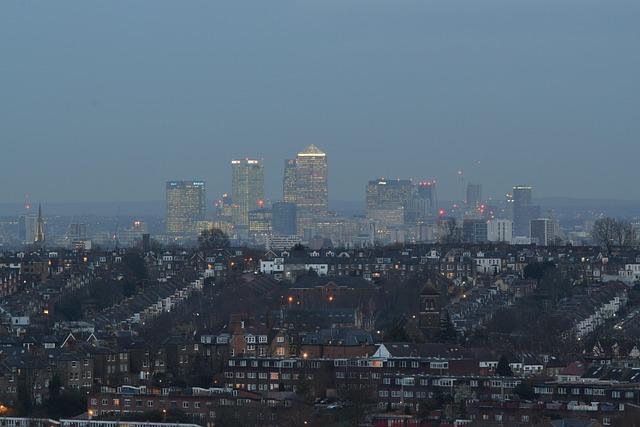
JPMorgan Chase, one of the world’s largest banking groups, is poised to benefit from a significant reduction in business rates on its landmark Canary Wharf headquarters, according to a report in The Times. The prospective discount, arising from changes in property valuations and appeals across London’s financial district, comes at a sensitive moment for the UK government as it faces mounting scrutiny over the fairness of the business rates system.With thousands of firms grappling with rising costs and shifting workplace patterns, the prospect of tax relief for a global banking giant is highly likely to intensify debate over how Britain taxes commercial property-and who ultimately gains from reforms designed to keep the City competitive.
JP Morgan set to benefit from business rates discount on Canary Wharf headquarters
City analysts say the Wall Street lender is poised to become one of the most prominent beneficiaries of the capital’s evolving property tax regime, as reliefs aimed at rejuvenating London’s financial districts begin to bite. Local officials are understood to be weighing up targeted support for large employers that commit to long-term leases and office refurbishment,a category that includes JP Morgan’s European headquarters in Canary Wharf. Policy insiders argue such measures are designed to keep blue-chip firms anchored in the Docklands, amid simmering competition from Paris, Frankfurt and other EU hubs.
For JP Morgan, any reduction in commercial levies could free up additional capital for investment in technology, office redesign and client-facing functions. According to people familiar with the matter, scenarios under discussion could deliver a meaningful cut in annual overheads, with potential ripple effects for jobs and local supply chains. Key areas likely to be watched by investors and policymakers include:
- Operational savings that could be redirected into digital infrastructure
- Long-term lease commitments that signal confidence in Canary Wharf’s future
- Market precedent for how other major banks may negotiate rate relief
| Factor | Potential Impact on JP Morgan |
|---|---|
| Business rates cut | Lower fixed costs at London HQ |
| Staff retention | More funds for workplace upgrades |
| Local economy | Stronger support for nearby services |
How shifting property valuations and remote work trends are reshaping London’s commercial tax base
As prime office towers across Docklands and the City are quietly revalued,the traditional map of who pays what in business rates is being redrawn. Remote and hybrid work have left swathes of blue-chip floor space underused, softening rents and prompting appeals that ripple straight into the tax ledger.In practice, this means a growing divergence between glass-and-steel financial hubs and more resilient mixed-use districts, with some global banks now eyeing considerable reliefs while smaller occupiers in thriving neighbourhoods shoulder a rising share of the burden. Local authorities, still heavily dependent on commercial property taxes, are caught between encouraging investment and plugging widening fiscal gaps.
The result is a more fragmented, less predictable tax base where location, use-class and workplace strategy matter as much as square footage. Policy-makers and investors are watching several fault lines emerge:
- Remote work drag: Persistent hybrid models weaken demand for legacy office stock, undermining historic valuations.
- Sector imbalances: Finance and tech footprints shrink as logistics, life sciences and data centres bid up fringe locations.
- Zone-by-zone disparities: Prime West End retail and flexible, amenity-rich hubs hold value better than monolithic office estates.
- Fiscal pressure: Boroughs reliant on big-ticket offices face sharper volatility in rate income and tougher budget decisions.
| Area | Valuation Trend | Work Pattern |
|---|---|---|
| Canary Wharf | Softening prime office values | High remote/hybrid usage |
| City Core | Selective repricing | Hybrid with peak midweek |
| West End | Resilient mixed-use | Office plus strong retail footfall |
What the rates relief means for Canary Wharf’s future as a global financial hub
The decision to ease the tax burden on one of the Wharf’s flagship towers sends a powerful signal to global banks weighing where to deploy capital and people. Lower fixed costs make it easier for institutions to commit to long-term leases, invest in upgraded trading floors and experiment with flexible, post-pandemic workplace models. For policymakers, the gamble is that a more competitive cost base will anchor blue-chip tenants in London rather than Frankfurt, Paris or New York, reinforcing the Docklands as a hub for high-value jobs, deal-making and international capital flows. Yet the move also underlines how reliant the estate remains on public incentives at a time when hybrid working, rising borrowing costs and shifting regulation are reshaping the geography of global finance.
For Canary Wharf Group and smaller occupiers, the recalibration of business rates could accelerate a broader repositioning of the district from a pure banking enclave into a mixed, globally oriented business ecosystem. A lighter tax load can unlock investment in:
- Green retrofits to meet net-zero standards demanded by multinational investors.
- Tech and fintech tenants that want proximity to banks without City of London price tags.
- Amenity-led regeneration – from life sciences labs to cultural venues – that keeps talent on the estate after trading hours.
| Factor | Impact on Canary Wharf |
|---|---|
| Business rates cut | Improves cost competitiveness vs. rival hubs |
| Tenant stability | Encourages long-term flagship leases |
| Diversification | Speeds shift into tech, ESG and life sciences |
| Global perception | Signals that London is willing to fight for finance |
Policy options for ensuring business rate incentives support investment without eroding the tax base
Designing reliefs that nudge banks and other blue‑chip occupiers toward long‑term, productive investment rather than short‑term tax arbitrage demands a more surgical approach from policymakers. One option is to make discounts conditional and time‑limited, linked to measurable outcomes such as net new jobs, green retrofits, or the repurposing of surplus office space into mixed‑use developments. Another is to embed automatic sunset clauses, forcing periodic review so that generous deals struck in one cycle do not quietly become permanent drains on municipal coffers in the next. Local authorities, under pressure to compete for marquee tenants, could be given clearer statutory guidance – and obvious caps – on how far they can go in trading away their future tax base for today’s headlines.
To prevent a “race to the bottom”, central government can pair adaptability with guardrails, creating a framework where baseline business rate yields are protected, and only performance‑linked top‑ups are negotiable. That might include:
- Tiered reliefs that taper as property values or profits recover.
- Clawback mechanisms if investment or employment pledges are missed.
- Openness rules requiring publication of major rate deals and their expected fiscal impact.
- Place‑based investment funds so part of any discount is recycled into local skills, transport or housing.
| Policy tool | Investor signal | Tax base effect |
|---|---|---|
| Time‑limited relief | Support during transition | Limits long‑term revenue loss |
| Outcome‑based discount | Reward for real investment | Aligns tax breaks with growth |
| Clawback clause | Discourages box‑ticking | Protects councils from under‑delivery |
Closing Remarks
As the government’s overhaul of business rates continues to ripple through the City, JP Morgan’s expected discount at Canary Wharf will be watched closely by rivals, policymakers and local authorities alike. For some, it will be held up as evidence that the system can still adapt to changing market realities; for others, it will underline a perception that the biggest players remain best placed to benefit.
What is clear is that the outcome will reach far beyond one bank’s balance sheet. It will help shape the conversation over how Britain taxes commercial property,how it competes for global capital and,ultimately,who pays the price for keeping London’s towers lit.