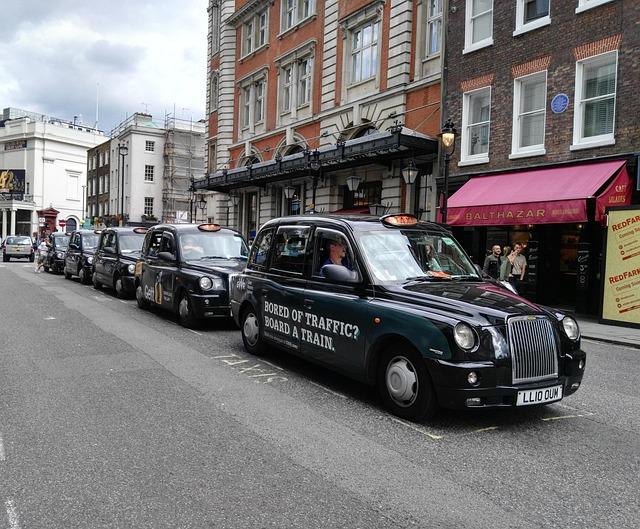
A driverless taxi collided with a police cordon at a double-stabbing crime scene in central London, raising fresh questions over the safety and regulation of autonomous vehicles on the capital’s streets. The incident,which occurred as detectives were scouring the area for evidence,saw the self-driving cab roll into the taped-off zone despite officers’ attempts to secure the perimeter. No further injuries were reported,but the bizarre crash has reignited debate about the readiness of driverless technology for complex,real-world situations-especially in fast-changing,high-stakes environments like active crime scenes. As investigators piece together the circumstances behind both the stabbings and the taxi’s unexpected incursion, regulators and industry figures are once again under pressure to explain how robust these systems really are.
Driverless taxi crashes into active London crime scene during double stabbing investigation
Detectives combing a cordoned-off London street for clues in a violent double stabbing were forced to pause their work after a so‑called “driverless” taxi rolled straight into the heart of the active crime scene. Witnesses said the cab,believed to be operating in semi-autonomous mode,slowly edged past police tape before bumping a forensic tent,sending officers scrambling to halt the vehicle and protect potential evidence. No one was injured in the low-speed collision, but senior investigators voiced concerns that the unexpected intrusion could compromise critical forensic traces at a stage when minutes and millimetres matter.
The incident has sparked fresh debate over the safety and oversight of emerging transport technologies on London’s already pressured streets. Residents and onlookers spoke of a surreal clash between cutting-edge automation and old-fashioned police work, as officers tried to secure both the scene and the wandering vehicle. Early inquiries are focusing on whether a technical fault, human error by a supervising driver, or a GPS-routing issue led the cab into the restricted area. Local concerns now centre on:
- Public safety: Potential risks posed by autonomous or semi-autonomous vehicles during emergencies.
- Police operations: How technology can disrupt time-sensitive forensic investigations.
- Regulation gaps: Whether current rules are robust enough for self-driving fleets in dense urban areas.
| Key Issue | Immediate Impact |
|---|---|
| Crime Scene Integrity | Risk of disturbed evidence |
| Tech Oversight | Questions over fail-safes |
| Public Trust | Renewed scrutiny of “driverless” cabs |
Safety and liability questions raised over autonomous vehicle operations in emergency zones
For investigators already juggling forensic timelines and shaken witnesses, the intrusion of a driverless taxi into an active cordon has sharpened focus on who carries the blame when algorithms cross the tape. Insurers, local authorities and police forces are now wrestling with overlapping responsibilities: the technology firm that wrote the code, the fleet operator that dispatched the vehicle, and the human “safety monitor” who may be supervising from miles away.Questions are being asked about whether current road traffic laws, drafted for fallible human drivers, can properly accommodate vehicles that respond only to sensor data and cloud-based instructions, especially in chaotic, low-visibility scenes lit by blue lights and hazard tape.
Behind the scenes, risk managers warn that every misstep in a crisis zone could set precedent for how compensation, criminal liability and regulatory sanctions are handled in future incidents. Emergency services are pressing for new, legally enforceable protocols to ensure that autonomous fleets recognize and respect temporary road closures, improvised cordons and shouted commands from officers. Industry sources say that means not just better object detection, but a clear chain of accountability when the software fails to recognise a crime scene at all.
- Key concerns: duty for injuries and scene contamination
- Legal gap: traffic laws built for humans, not code
- Operational risk: AVs misreading lights, tape and crowds
- Public trust: shaken confidence in “safety first” claims
| Scenario | Primary Liability Debate |
|---|---|
| Crime scene breach | Operator vs. software provider |
| Injury to officer | Insurer vs. manufacturer |
| Evidence disturbed | Police vs. fleet owner |
| Faulty emergency mapping | Local authority vs. AV platform |
Regulators urged to tighten protocols for driverless cars near police cordons and road closures
Safety campaigners and legal experts are pressing ministers and transport regulators to move beyond voluntary guidance and introduce mandatory, high-precision rules for how autonomous vehicles behave around emergency incidents. They argue that current systems, which rely heavily on generic hazard detection and map data, are ill‑equipped to interpret fast‑changing crime scenes, taped‑off pavements or dynamic police cordons. Among the proposals gaining traction are real‑time digital alerts from police control rooms to vehicle operators, stricter geofencing around active investigations, and automatic low‑speed “crawl modes” when blue lights, flares or high‑visibility barriers are detected.
- Real‑time data feeds from emergency services to fleet operators
- Mandatory “no‑go” zones around active cordons and crash sites
- Independent black‑box style logging of all autonomous decisions
- Clear liability rules for software, operators and manufacturers
| Priority Area | Proposed Measure |
|---|---|
| Detection | Enhanced vision for tape, cones, police vests |
| Communication | Encrypted police-to-vehicle alerts |
| Control | Automatic handover to remote human operator |
| Enforcement | Fines and suspensions for protocol breaches |
Insurers, too, are warning that without clear standards for cordon awareness and road‑closure logic, the risk profile for autonomous taxis could spike, pushing up premiums and deterring wider rollout. Civil liberties groups,meanwhile,want stronger governance of the data generated when self‑driving cars record sensitive scenes,from major crime investigations to anti‑terror operations. The emerging consensus is that the technology can coexist with frontline policing only if it is indeed bound by robust, enforceable protocols-rules that treat temporary tape and flashing lights with the same gravity as permanent traffic signals.
Policy recommendations for integrating autonomous taxis into urban incident response planning
City planners can no longer treat autonomous taxis as a novelty operating on the margins of public safety. To avoid a repeat of a self-driving cab gliding into a taped-off crime scene, transport and policing bodies should establish joint protocols that define exactly how robotaxis behave around cordons, emergency lights and diversion zones. This means mandating real-time data sharing between fleet operators and control rooms, integrating AV fleets into existing computer-aided dispatch systems, and requiring geo-fencing rules that automatically reroute vehicles away from active incidents. Clear licensing conditions should force operators to maintain a 24/7 human oversight centre able to intervene instantly, while regulators develop incident playbooks that cover everything from major crimes to burst water mains.
Embedding these vehicles safely into the urban emergency ecosystem also demands a new training and audit regime.Police, fire and ambulance teams need joint exercises with AV operators, so responders understand how to disable a vehicle, request logs or establish secure perimeters in the presence of driverless cars. Simultaneously occurring, city halls should adopt measurable performance standards, including penalties when autonomous fleets repeatedly ignore closures or obstruct first responders. Key policy levers include:
- Dynamic exclusion zones automatically pushed to AV maps during live incidents.
- Standardised digital signals for road closures,replacing improvised cones and tape alone.
- Transparent incident reporting from AV operators to safety regulators and the public.
- Urban design tweaks such as dedicated AV lay-bys to prevent vehicles stopping in sensitive areas.
| Policy Tool | Primary Goal |
|---|---|
| Geo-fenced no-go zones | Keep AVs out of active scenes |
| Shared incident feeds | Synchronise maps and cordons |
| Joint drills | Train responders with AV fleets |
| Licensing conditions | Enforce safety-by-design |
Key Takeaways
As investigations into both the double stabbing and the driverless taxi collision continue,the incident will likely fuel renewed scrutiny of autonomous vehicle trials on Britain’s roads. For now,the unanswered questions – about safety protocols,regulatory oversight,and the technology’s limits in unpredictable,high-stress scenarios – will loom large over a sector eager to prove its reliability.
What unfolded on that London street was more than a traffic mishap at a crime scene; it was a stark reminder that the race to automate transport is colliding with the messy realities of urban life. Law enforcement, policymakers and technology firms will now be under pressure to show that innovation can keep pace not just with ambition, but with public safety.