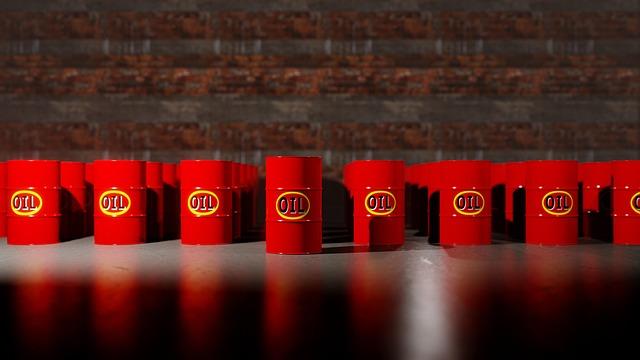
Oil prices held within a narrow range this week as markets balanced cautious optimism against persistent global uncertainty. Traders and analysts in London point to a fragile equilibrium: demand signals remain uneven,geopolitical risks continue to simmer,and central banks’ next moves on interest rates are far from clear. Yet, despite this unsettled backdrop, crude benchmarks have so far avoided the sharp swings that have characterised previous periods of turbulence, suggesting that for now, stability rests on a knife edge.
Global oil benchmarks hold steady as markets weigh geopolitical risks and muted demand signals
Brent and WTI contracts traded within a narrow band in early London dealings, as traders weighed simmering tensions in key producing regions against a backdrop of lacklustre consumption data from major importers. The latest figures show refiners in Europe and parts of Asia trimming throughputs, suggesting that higher borrowing costs, mild winter forecasts and slowing manufacturing activity are eroding demand growth expectations. This push-and-pull dynamic is encouraging a wait‑and‑see stance across the market, with speculative positioning subdued and physical cargo differentials showing only modest moves.
Analysts note that pricing has become increasingly headline‑driven, yet underlying fundamentals are sending mixed signals. Market participants are closely tracking:
- Geopolitical flashpoints near shipping chokepoints that could disrupt crude flows.
- OPEC+ compliance with existing output targets and any hints of deeper cuts.
- Inventory trends in the US and OECD hubs as a barometer of real‑time demand.
- Macroeconomic data, including PMI readings and central bank guidance on rates.
| Benchmark | Price (USD/bbl) | Daily Move | Key Driver |
|---|---|---|---|
| Brent | 82.40 | +0.12% | Caution over Middle East supply |
| WTI | 78.10 | +0.05% | Soft US demand, firm exports |
| Dubai/Oman | 80.70 | -0.08% | Muted Asian refinery margins |
Central bank policy jitters and inflation fears keep energy investors on the sidelines
Trading desks are increasingly treating the oil market as a barometer for central bank conviction rather than purely supply-demand fundamentals. With policymakers in the US, UK and eurozone sending mixed signals on the timing and pace of rate cuts, portfolio managers are reluctant to deploy fresh capital into energy equities or longer-dated crude contracts.The risk that sticky core inflation forces rates to stay higher for longer is prompting funds to sit on excess cash, waiting for clearer guidance from the Federal Reserve and the Bank of England before taking directional bets. This stand-off has translated into thinner volumes and a tighter trading band, with price moves driven more by macro headlines than by inventory data or OPEC soundbites.
Against this backdrop, inflation expectations have become just as significant as refinery runs or shipping flows. If central banks misjudge the balance and policy tightening deepens a slowdown, demand destruction could offset any price support from supply curbs. Conversely, a premature pivot might reignite price pressures, risking renewed volatility. As a result, analysts say investors are now running through multiple rate-path scenarios and stress-testing energy exposures accordingly, often shifting into more defensive or inflation-resilient assets.
- Macro data releases now move crude benchmarks as much as inventory reports.
- Rate path uncertainty is delaying large-position build-ups in futures.
- Inflation surprises are pushing traders toward shorter holding periods.
| Key Driver | Investor Reaction |
|---|---|
| Hawkish central bank tone | Reduced exposure to cyclical energy stocks |
| Sticky services inflation | Preference for cash and short-term paper |
| Dovish shift in guidance | Cautious re-entry into crude and product futures |
Refiners and producers adjust strategies amid narrow margins and uncertain consumption outlook
With crack spreads compressed and demand forecasts being revised almost monthly, operators are quietly reshaping how and what they produce. Many are tilting runs toward higher-margin outputs such as petrochemical feedstocks and aviation fuel, while trimming gasoline output in mature markets where efficiency gains and electric vehicles are steadily eroding volumes. Simultaneously occurring, planned turnarounds are being brought forward or extended, allowing plants to install digital monitoring systems, debottleneck key units and trial co-processing of bio-based inputs without sacrificing near-term profitability. This incremental, low-profile retooling reflects a sector that is wary of over-investing in capacity that may never be fully utilised.
Producers upstream are pursuing an equally cautious playbook, seeking to protect cash flow while maintaining optionality. Capital is being redirected from frontier exploration toward short-cycle projects and infill drilling that can be ramped up or down quickly, and marketing teams are widening their customer base to include smaller self-reliant traders and regional refiners willing to sign flexible offtake agreements. Common themes across the value chain now include:
- Portfolio optimisation: divesting older, energy-intensive assets and prioritising integrated complexes.
- Risk hedging: using more sophisticated hedging strategies to lock in narrow but reliable margins.
- Selective diversification: expanding into low-carbon fuels and hydrogen where existing infrastructure can be leveraged.
| Strategy Focus | Refiners | Producers |
|---|---|---|
| Capital discipline | Delay large expansions | Shift to short-cycle projects |
| Product mix | More jet, less gasoline | Blend output toward lighter crudes |
| Transition plays | Biofuels co-processing | Low-carbon pilot projects |
What UK businesses and policymakers should do now to manage fuel costs and supply vulnerabilities
With benchmark crude holding steady yet fragile, UK firms should treat this as a window to harden their operations against the next price spike. Finance teams can deploy hedging strategies, negotiate multi-year contracts with transparent index-linking, and benchmark suppliers using clear metrics on reliability, emissions and delivery performance.Operationally, businesses can invest in fuel-efficient fleets and plant, adopt telematics to curb idling, and switch non‑critical processes to off‑peak or lower‑intensity energy sources. Simple but disciplined measures help too, including:
- Consolidating deliveries to reduce mileage and exposure to pump volatility
- Diversifying fuel types, from HVO blends to early-stage EV and hydrogen pilots
- Stress-testing supply chains against disruptions at key ports, refineries or choke points
- Sharing demand forecasts with suppliers to secure priority allocation in tight markets
Policymakers, meanwhile, can turn a period of relative calm into a platform for structural reform. That means sharpening incentives for efficiency and alternative fuels, accelerating grid upgrades that unlock electrified transport, and using targeted relief for the most fuel‑intensive SMEs rather than broad, blunt subsidies. Regulators can also work with industry to standardise data on fuel usage and resilience, creating clearer signals for capital investment. The table below highlights priority moves on both sides:
| Actor | Immediate Step | Strategic Goal |
|---|---|---|
| Businesses | Lock in flexible supply contracts | Predictable costs across price cycles |
| Businesses | Audit fuel use and fleet efficiency | Lower exposure per unit of output |
| Policymakers | Targeted support for high‑risk sectors | Prevent fuel shocks from driving insolvencies |
| Policymakers | Scale EV and alternative fuel infrastructure | Reduce structural dependence on oil |
in summary
As markets continue to weigh mixed economic signals, geopolitical tension and shifting supply dynamics, oil’s current steadiness may prove as fragile as it is indeed welcome. For now, prices remain rangebound, offering a degree of predictability for businesses and consumers.Yet with central banks, OPEC+ producers and global policymakers all poised to influence the next move, the outlook is anything but settled. In the weeks ahead, traders and industry leaders alike will be watching not just where prices go, but what they reveal about the underlying health of the global economy.