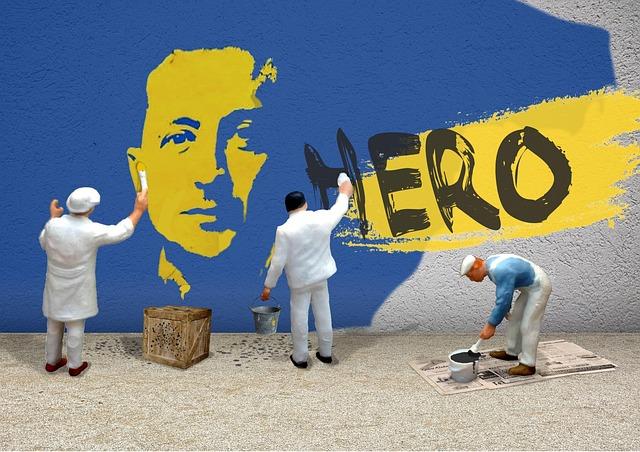
Ukrainian President Volodymyr Zelensky has issued his starkest warning yet to European leaders, cautioning that the consequences of wavering support for Kyiv will extend far beyond Ukraine‘s borders. In a series of high-level talks and public statements, Zelensky has urged Europe to recognize that Russia’s war is not a regional conflict, but a direct challenge to the continent’s security architecture, economic stability and political unity. As London and other European capitals grapple with war fatigue,budget pressures and shifting domestic priorities,his message is clear: any fracture in Western resolve could embolden Moscow,destabilise markets and redraw the strategic map of Europe for years to come. This article examines the substance of Zelensky’s warning, the response from European allies, and what is at stake for the UK and the wider European economy.
Escalating Russian aggression and dwindling Western stockpiles reshape Europe’s security calculus
As missile salvos rain down on Ukrainian cities and Russian defense factories move to a war footing, European defence planners are being forced into a sobering reappraisal of their assumptions. The post-Cold War belief that high‑intensity conflict was an abstract risk has collided with the reality of an industrial‑scale war on the EU’s doorstep, exposing how limited NATO’s conventional reserves have become after two years of emergency transfers to Kyiv. Senior generals now warn that Europe’s ability to sustain even a few weeks of full‑spectrum combat is constrained by shortages of artillery shells, air‑defence interceptors and armoured vehicles. In closed‑door briefings,diplomats describe a shift from debating how much support to give Ukraine to asking whether Europe itself could withstand a similar onslaught.
This strategic rethink is playing out in defence ministries and boardrooms across the continent, where leaders are weighing hard choices:
- Rearmament vs. fiscal restraint – whether to break long‑standing budget taboos to fund multi‑year weapons contracts.
- National stockpiles vs. Ukrainian front lines – how to balance immediate deliveries to Kyiv with the need to rebuild their own reserves.
- Autonomy vs. US dependence – how quickly Europe can stand up its own industrial capacity as Washington’s political commitment grows less predictable.
| Key Pressure Point | Current Reality | Emerging Response |
|---|---|---|
| Artillery ammunition | Stocks depleted by Ukrainian support | Joint EU procurement & new shell plants |
| Air defence | Limited Patriot & IRIS‑T batteries | Layered systems and shared coverage |
| Industrial capacity | Peacetime production rhythms | Shift to multi‑shift, long‑term contracts |
| Political will | Fragmented national priorities | Push for binding defence commitments |
Why fragmented defence spending leaves EU states vulnerable to sudden shocks
Across the continent, defence budgets are rising, but they remain splintered along narrow national lines, creating overlapping programmes and critical gaps that no single capital can plug alone.States often prioritise domestic industrial interests over collective capability, resulting in a patchwork of systems that struggle to communicate on the battlefield and to scale when crises erupt. Long procurement cycles,combined with multiple incompatible platforms,make it harder to surge ammunition,air defence assets or cyber-defence tools at short notice. When one key supplier is disrupted-by sanctions, sabotage or market turmoil-the knock-on effects travel quickly through this fragile ecosystem.
This disunity leaves governments exposed to cost shocks and strategic surprises. When threats escalate suddenly, leaders are forced into emergency purchases at premium prices, bidding against their own neighbours for the same missiles, drones or spare parts. The absence of a consolidated European defence market also weakens bargaining power with major contractors, limiting the ability to secure secure long-term supply guarantees. As Zelensky presses his case, officials in Brussels and national capitals are quietly acknowledging that only joint planning, shared stockpiles, and interoperable equipment can cushion Europe against the next wave of geopolitical turbulence:
- Duplicated programmes drain budgets without boosting readiness.
- Incompatible systems slow coordination in a fast-moving crisis.
- Fragmented procurement inflates costs and delays delivery.
- Uneven stockpiles make some states critical weak links.
| Risk Factor | Impact on EU Security |
|---|---|
| National-only procurement | Higher costs, slower scaling |
| Limited joint stockpiles | Shortages during sudden crises |
| Divergent standards | Reduced battlefield interoperability |
| Supplier dependence | Vulnerability to external shocks |
Urgent steps for European governments to harden energy, cyber and infrastructure resilience
European leaders can no longer treat energy security and cyber defence as separate files gathering dust in different ministries; they must be fused into a single, war-time resilience agenda. Governments need to move rapidly from policy papers to physical protections: reinforcing critical substations and LNG terminals, dispersing gas storage across borders, and hardening key undersea cables and data hubs against sabotage. This demands joint procurement of defensive technologies, cross-border stockpiles of essential components, and fast-track permitting for redundancy infrastructure such as backup interconnectors, mobile transformers and modular power units. To keep public support on-side, capitals should publish clear, actionable contingency plans and invest in real-time risk communication, explaining in plain language what citizens can expect – and how governments are preparing to keep the lights on and networks running.
- Energy: Shield high-value assets, diversify supply routes, expand storage, accelerate grid interconnectors.
- Cyber: Mandate 24/7 security operations for operators of essential services, stress-test banking and energy IT, share threat intelligence in hours, not weeks.
- Physical infrastructure: Harden rail, ports, telecom hubs and satellite ground stations with surveillance, access controls and rapid repair units.
- Regulation & funding: Tie public subsidies to resilience benchmarks, and unblock emergency EU and national funds for defensive upgrades.
| Priority Area | Immediate Action | Timeline |
|---|---|---|
| Power Grid | Install backup transformers at cross-border nodes | 3-6 months |
| Gas & LNG | Secure terminals with military-grade surveillance | 6-9 months |
| Cyber Defence | Continuous red-teaming of utilities and banks | Start within 30 days |
| Communications | Backup satellite links for government networks | 6-12 months |
How coordinated sanctions and long term arms commitments can deter further Kremlin escalation
European leaders increasingly recognise that fragmented measures only invite Moscow to test the boundaries, probing for gaps in resolve.By contrast, a tightly synchronised web of financial, technological and energy sanctions, backed by clear red lines, can raise the costs of aggression to a level the Kremlin cannot ignore. This means not just freezing oligarch assets or banning select exports, but also aligning enforcement deadlines, closing loopholes in maritime trade, and targeting the dual-use technologies that sustain Russia’s war machine. Coordinated action among EU states and the UK, combined with pressure on third countries facilitating sanctions evasion, sends a unified signal: escalation will be met with automatic, predictable penalties, not hesitant diplomacy.
- Lock in multi‑year arms packages with cross‑party support
- Synchronise sanctions triggers for any new attacks on civilians or infrastructure
- Guarantee ammunition and air‑defence supplies on an industrial, not ad‑hoc, scale
- Integrate training and maintenance into all major weapons transfers
| Measure | Desired Kremlin Signal |
|---|---|
| Oil & gas sanctions | War profits will shrink, not grow |
| Long-term arms pledges | Time is not on Moscow’s side |
| Tech export controls | Modern weapons will be harder to replace |
| Joint enforcement taskforces | No safe harbour for sanctions evasion |
Equally crucial is the credibility of Western commitments to Ukraine’s defence capabilities over the long haul. Multi‑year, budgeted arms agreements-rather than sporadic announcements-undercut the Kremlin’s belief that fatigue in European capitals will eventually deliver a battlefield advantage. When parliaments in London, Berlin and Paris hard‑wire replenishment of missiles, artillery shells and air defences into their defence planning, Russia faces a strategic equation in which each attempted escalation guarantees a stronger, better‑equipped Ukrainian response. That combination of sustained firepower and economic isolation does not merely react to aggression; it shapes Moscow’s calculations in advance, making further expansionist gambits both riskier and less lasting.
In Retrospect
As Zelensky’s words reverberate across Europe’s capitals, the message is unambiguous: the outcome of the war in Ukraine will shape the continent’s security architecture for decades to come. His warning is not merely about the immediate risk of battlefield setbacks, but about the broader erosion of deterrence, the testing of Western unity and the precedent that unchecked aggression could set.
For European leaders, the choice is narrowing. Either they respond with the sustained political will, financial resources and military support Zelensky insists are essential, or they risk a more perilous and unstable Europe on their doorstep.As budgets are drawn up and electorates grow weary, Kyiv’s plea serves as a stark reminder that the costs of inaction may ultimately far outweigh the price of continued support.
Whether Europe meets this moment with resolve or hesitation will not only define Ukraine’s fate, but also the credibility of the West’s commitment to its own security and values.