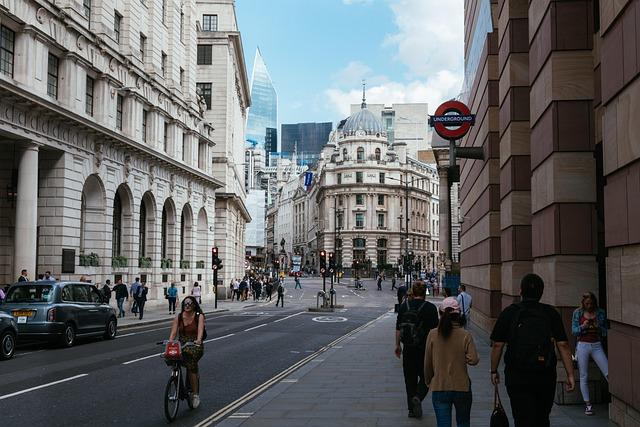
In a city where centuries-old guildhalls stand steps away from fintech start-ups and creative studios, London has become more than a global capital-it is a living laboratory for innovation. From the rise of AI-driven finance in the Square Mile to the boom in purpose-led enterprises in Shoreditch, the metropolis is continuously testing new ideas about how business can and should work.At Bayes Business School, researchers and industry leaders are using London’s dense network of entrepreneurs, investors, policymakers, and creatives as a real-time testbed, examining how experimentation, cross-sector collaboration, and bold thinking are reshaping the future of commerce.This article explores how the city’s unique mix of history, diversity, and disruption is turning London into a proving ground for the next generation of business models.
London as a Living Testbed for Corporate Innovation and Urban Experimentation
In the capital,global corporates,scaleups and public agencies effectively share a live prototype of tomorrow’s city. From Canary Wharf‘s fintech sandboxes to King’s Cross’s data-driven placemaking, organisations treat streets, stations and skyline as an integrated R&D platform, testing everything from AI-powered logistics to real-time energy management in everyday conditions. This density of experiments is backed by a regulatory environment that actively enables trial-and-error: flexible planning frameworks, open-data mandates and fast-track pilots allow firms to iterate quickly, fail visibly and scale what works. For executives, this turns London into a de‑risked arena where ideas are stress-tested not in simulations, but against rush-hour crowds, complex supply chains and demanding citizens.
What makes the ecosystem distinctive is the way corporate ambition intersects with civic priorities. Multinationals, startups and local authorities increasingly co-design pilots that must work both commercially and socially, with a growing emphasis on sustainability, inclusion and digital trust.
- Real-time urban analytics informing retail, transport and policing strategies.
- Low-carbon districts operated as collaborative labs for net-zero solutions.
- Immersive customer experiences blending physical and digital services.
- Regulatory sandboxes offering controlled environments for high-risk ideas.
| Prototype Zone | Focus Area | Corporate Edge |
|---|---|---|
| City Cluster | Fintech & RegTech | Live trials with regulators and banks |
| West End | Retail & Experience | Instant customer feedback at global scale |
| East London | Green Mobility | Testing EV, micromobility and logistics routes |
How Bayes Business School Harnesses the City’s Ecosystem to Shape Future Leaders
Embedded in the financial heart of London, the school turns the city into a live case study where theories are tested against real market pressures. Students engage with start-ups in Shoreditch, fintech disruptors in Canary Wharf, and global institutions in the Square Mile, transforming conventional lectures into field investigations. Through curated consultancy projects, hackathons, and shadowing schemes with senior executives, learners work on live briefs that mirror the volatility and opportunity of contemporary business.This constant exposure to boardroom negotiations, regulatory debates, and investor decision-making cultivates leaders who are as comfortable decoding data dashboards as they are navigating stakeholder politics.
The curriculum is woven directly into London’s innovation fabric through partnerships with incubators, accelerators and venture studios. Faculty members frequently co-design modules with industry partners, ensuring content reflects current shifts in areas like enduring finance, AI governance and impact investing. Students benefit from an ecosystem that includes:
- Innovation labs that host joint research with fintech and health-tech firms.
- Mentoring circles run by alumni working in private equity, consulting and social enterprise.
- Live policy forums where regulators,founders and investors debate emerging rules.
- City-wide challenges that pair student teams with local councils and NGOs.
| City Asset | Student Experience | Leadership Skill |
|---|---|---|
| Financial District | Deal simulations with banks | Strategic decision-making |
| Tech Clusters | Prototype testing with start-ups | Agile innovation |
| Policy Hubs | Roundtables with regulators | Ethical judgment |
| Cultural Sector | Brand labs with creative agencies | Storytelling & influence |
From Startups to Multinationals Strategies for Turning London’s Creative Energy into Competitive Advantage
Whether bootstrapping in a Shoreditch co-working loft or steering a global HQ in Canary Wharf, businesses that thrive in the capital learn to treat the city as a live prototype lab.Startups harness its dense networks and cultural collisions by embracing rapid experimentation, collaborating with universities and accelerators, and recruiting from diverse creative communities. Established corporations, in contrast, leverage London’s ecosystem to pilot new business models at low risk-ring‑fencing agile teams, acquiring niche creative boutiques, and testing products in micro‑markets before scaling them worldwide. What unites them is a mindset that views London’s energy not as background noise, but as data: a continuous stream of behaviours, trends, and ideas to be captured, decoded, and turned into strategic insight.
To convert this kinetic environment into an enduring edge, organisations of every size tend to rely on a similar playbook:
- Embed in the ecosystem – base innovation teams near creative districts and coworking hubs.
- Co-create with communities – involve local makers, artists, and students in product design.
- Test fast, public, and small – launch pilots in specific boroughs before global rollouts.
- Blend art with analytics – pair designers and storytellers with data scientists in cross‑functional squads.
- Translate local signals into global plays – treat London insights as early indicators of international shifts.
| London Player | Creative Tactic | Competitive Payoff |
|---|---|---|
| Early-stage startup | Pop-up pilots in markets and festivals | Real-time product validation |
| Scale-up | Partnerships with art schools and labs | Distinctive brand and IP |
| Multinational | Dedicated London innovation studio | Exportable global prototypes |
Building Resilient Businesses Practical Playbooks for Experimentation Collaboration and Sustainable Growth in London
In a city where market shocks are as common as morning tube delays, resilience is no longer a buzzword but a design principle for how companies operate. London’s most adaptable firms treat the capital as a live testbed, running small, low-risk trials before committing big budgets. These experiments span everything from pricing models to circular supply chains, supported by a rich ecosystem of incubators, accelerators and university labs. At their core are a few simple habits: rapid feedback loops,ruthless measurement,and a willingness to retire legacy practices that no longer serve. Leaders are shifting from rigid five-year plans to dynamic playbooks that are updated as data, technology and regulation evolve.
- Experiment fast, fail small – pilot offerings in one borough or customer segment before scaling.
- Co-create with stakeholders – involve customers, suppliers and communities early in product design.
- Design for sustainability – embed circularity and low-carbon choices into operations from day one.
- Share data, not just opinions – build cross-company dashboards that align teams on the same metrics.
| Playbook | London Example | Resilience Gain |
|---|---|---|
| Micro-market pilots | Fintech tests new fees in Shoreditch only | Limits risk, speeds learning |
| Shared innovation labs | Retailers and startups co-work near King’s Cross | Faster cross-sector solutions |
| Green partnership deals | Logistics firms share electric fleets in Zone 2 | Cuts costs and emissions |
By institutionalising these approaches, companies build the capacity to absorb shocks and capture new opportunities without constant reinvention. Collaboration replaces siloed strategy documents: rival firms share infrastructure to manage volatility in energy prices; SMEs form buying clubs to negotiate better rates; and creative agencies partner with technologists to prototype products that are both commercially viable and climate-aware. The emerging playbook is clear: the most resilient London businesses are those that can experiment together, iterate in public and turn the city’s complexity into a competitive advantage that compounds over time.
Final Thoughts
As London navigates an era defined by rapid technological change, shifting consumer expectations, and intensifying global competition, its role as a living laboratory for innovation is only likely to grow. From AI-enabled finance to creative industries reshaping urban life, the city’s density of ideas, capital, and talent continues to generate new business models at a pace few places can match.
For Bayes Business School, this environment is more than a backdrop: it is indeed an active testing ground. By embedding research, teaching, and corporate partnerships in the fabric of the city, Bayes both observes and shapes how organisations respond to volatility and opportunity. The lessons emerging from London’s experiments in creativity and enterprise are not confined to the capital; they offer a blueprint for businesses everywhere seeking to innovate responsibly and at scale.
In that sense, London is less a finished story than an evolving prototype. The companies, policymakers, and educators who engage with this urban lab today are not just reacting to the future of business-they are helping to design it.